


Unlocking You: A Journey through Emotional Intelligence
- Year of You Staff
- May 30, 2025
- 5 min read
Welcome to the next dial in on the C.H.O.I.C.E.S. series, Insight.

Congratulations on reaching the midway point of the C.H.O.I.C.E.S. series! Whether you're just beginning or revisiting, the C.H.O.I.C.E.S framework (developed by Dr. Erica), this tool provides invaluable guidance for personal growth and navigating life's complexities.
Recap: The acronym C.H.O.I.C.E.S embodies key strategies
We have introduced the first three concepts: Communication, Honesty, and Opportunity. These elements are crucial for strengthening relationships, resolving conflicts, enhancing decision-making, being true to one’s values, and embracing challenges for personal growth. The next concept on the dial is Insight, which focuses on understanding your strengths, weaknesses, motivations, and potential. While drawing on insights to guide your choices, you can inform your actions and shape your personal growth.
Each concept within the C.H.O.I.C.E.S framework will resonate differently depending on your phase of life and personal experiences. Focusing on a specific concept within the framework (like Communication) is normal, especially if it presents a more significant challenge.
For instance, we discussed previously that communication can be difficult for some, as one might struggle with expressing feelings or engaging in meaningful conversations due to the advancement of technology. Information sharing has tripled over the past 3 decades. Despite technological growth, this advancement has adversely affected society. Specifically, individuals' emotional intelligence has declined due to the prevalence of smartphones and social media. In-person connection is no longer a priority and is potentially becoming more daunting, which causes an increase in isolation.
However, Communication, Honesty, and seizing Opportunities remain essential, as these factors significantly improve our overall well-being, such as relationship satisfaction and career satisfaction, to name a few.
Whether you focus on one or all of these concepts, keep them in mind as we add another to enrich your personal growth journey.

Introduction to Insight
Insight refers to the ability to understand the inner nature of things or the ability to see deeply into a situation. When it comes to Insight in the C.H.O.I.C.E.S framework, most of the ability to have Insight will come from understanding your emotions. Psychologist Dr. Robert Plutchik researched emotions and identified eight primary emotions - anger, fear, sadness, disgust, surprise, anticipation, trust, and joy.

Based on these emotions, he created the wheel of emotions to illustrate the interplay/balance between opposing emotional states, which can range from positive or negative. For instance, anger finds its counterpart in fear (a negative emotion), while sadness contrasts with joy (a positive emotion). Moreover, he emphasized that these emotions serve as behavioral responses crucial for survival and adaptation to our environment.
When we experience anxiety, our body instinctively trigger a flight or fight response, accompanied by the release of cortisol (a stress hormone). Like a sophisticated processor, the human body swiftly processes information consciously and unconsciously within milliseconds. However, traumatic experiences can disrupt these processes, altering an individual's life trajectory.

Wheel of Emotions as introduced by Dr. Robert Plutchik
We can also look to other sources to understand emotions. Chinese Medicine identifies that specific organs are interconnected with emotional energy. These organs are the way in which emotions are processed within the body and how the body responds to feelings. For example, if we release our feelings of anger or sadness in a healthy manner (like talking to someone or journaling our thoughts) the body will not hold on to the energy and be impacted. However, if negative energy is not released in a healthy manner (like an unresolved traumatic event from childhood abuse, a break-up/divorce, death in a family, or frequent exposure to stress like a job loss, financial issues, or chronic health issues) our organs and body will experience long term effects , like chronic health issues, disease or mental health concerns.

Based on Chinese Medicine, the interconnection of the body and emotions:
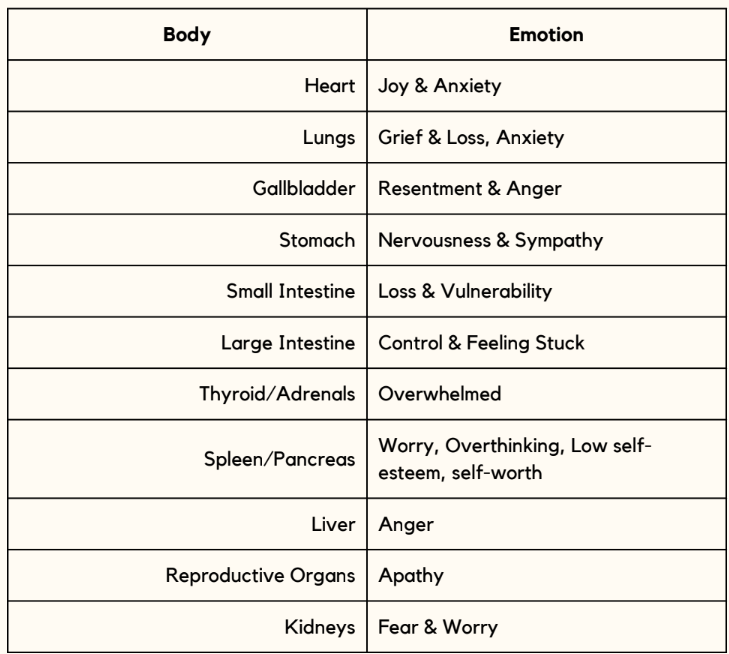
Lee et al. 2017 Evid Based Compl Alternat Med.
Vanbuskirk 2023 How Emotions and Organs are Connected in Trad Chinese Medicine.

These sections underscore the necessity of developing an acute awareness of our internal emotional landscape as well as the intricate connection between different organs and corresponding emotional states for building the foundation of Insight.
We now turn to enhancing our understanding of emotions in our behavior and interactions (i.e., Emotional Intelligence; EQ).
Insight and Emotional Intelligence
Our responses to the environment are translated through energy pulses understood through intuition or Insight. While these reactions are often considered unsafe, acknowledging and understanding them is crucial for emotional well-being. By learning to listen closely to our inner voice and understand the physical and emotional signals our body sends, we can better manage these diverse emotional experiences, enhancing our overall emotional intelligence and well-being.
Emotional intelligence (E.Q.), distinct from I.Q., involves recognizing and managing one's emotions and those of others. In 1995, Daniel Goleman re-introduced E.Q., and the term became more widely known. Understanding ones emotions is an ongoing, profound journey of curiosity, openness, and humility. This self-exploration is essential for well-being and harnessing our inherent strengths and weaknesses in life choices.

Central to this journey is Insight. It involves recognizing internal cues and comprehending the cause and effect of our actions through self-reflection. Insight also requires stillness and attention to your internal voice, a challenging task for many who find silence uncomfortable. Yet, insight is the cornerstone of emotional intelligence, enabling us to understand and manage our emotions and those of others.
Developing emotional intelligence, however, is often challenging. Emotional instability, fueled by fear or lack of support in expressing one's true emotions, is a common obstacle. Societal norms can pressure us to suppress genuine feelings like sadness, anger, or fear, stunting our emotional growth and authenticity. Daniel Goleman's model of emotional intelligence encompasses five key components: Self awareness, Self-Regulation, Motivation, Empathy, and Social Skills. Each element is crucial. Self-awareness allows us to recognize our needs and limitations. Self-regulation prevents us from being dominated by impulsive emotions. Motivation drives persistence through challenges. Empathy deepens our connections with others, and social skills enable us to navigate these relationships.
Recognizing barriers such as fear and lack of support is as important as embracing the components of emotional intelligence. Overcoming these barriers involves the courage to confront and express our true emotions in a world that often values restraint.
The Liberation of Insight for Self-Discovery
The path of Insight, self-discovery, and emotional intelligence is not just about self improvement but liberation. It frees us from fear and unsupportive environments. We can navigate life with clarity, balance, and fulfillment by embracing our true emotions and leveraging Goleman's emotional intelligence framework.
Let us embark on this journey with an open heart, accepting our emotional range and unlocking the potential to make informed, compassionate, and deeply resonant decisions. The C.H.O.I.C.E.S. we make ultimately shape our lives and every decision is an opportunity for growth and self-improvement. Take the first step of Insight today and start exploring your emotional landscape with courage and curiosity. To help you practice delving deeper into understanding your emotions we invite you to revisit the activity from “Exploring Resilience: From Feeling to Healing.”


Comments