


Not Everything Needs Your Yes

Welcome back to the Year of Y.O.U. newsletter!
Today, we introduce the concept of Overfunctioning and how the short-term benefits may outweigh the long-term costs.


Sometimes being “dependable” can take its toll
Welcome back to the Year of Y.O.U.!
In March, we focused on “Spring Cleaning for Your Brain” by clearing mental clutter, softening self-criticism, and creating space for clarity and creativity to return. As many of you may have noticed, when the noise quiets, something else becomes easier to see: Patterns.
Identifying Patterns Can Help Bring Clarity
April invites us to gently explore one of the most common patterns hiding beneath productivity and responsibility: the habit of saying yes to everything, or what family systems theorist Murray Bowen describes as “overfunctioning.” Overfunctioning occurs when someone consistently takes on more responsibility, effort, or emotional labor than is truly theirs to carry, often stepping in to manage, fix, or hold things together for others. While this pattern can look admirable on the outside, it often develops as a way to reduce conflict or maintain stability in relationships. Over time, it can come at the cost of one’s own energy and well-being with long-lasting consequences.
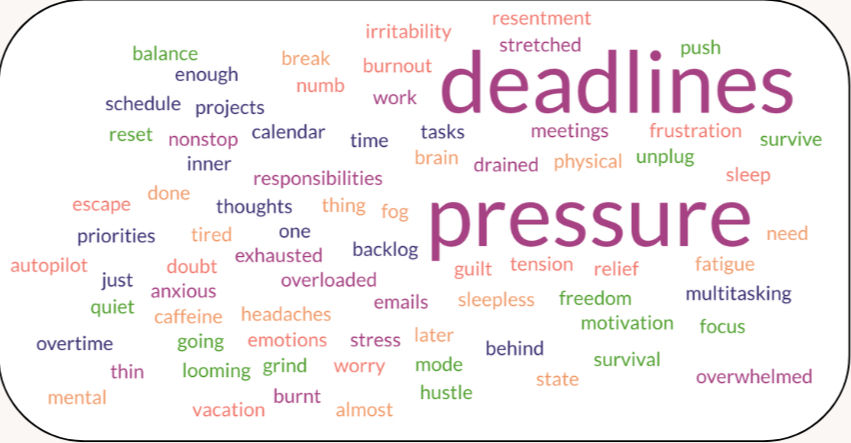
Overfunctioning seems like a great thing. You are dependable and capable. You are the one who anticipates needs, manages details, solves problems, and keeps things moving. You may be the person others can rely on at work, in your family, in relationships. But beneath that capability, there’s a quiet exhaustion that others cannot see and you may have learned to ignore.
This month is an invitation to notice when responsibility quietly turns into carrying more than what is yours to hold.
Many people develop this pattern early in life. Being prepared may have kept you safe. Staying ahead may have prevented conflict. Meeting others’ needs may have helped secure connection. These strategies worked in environments where being prepared, helpful, or self-sufficient reduced risk, conflict, or disconnection. They helped you navigate challenging environments. Yet, what once protected you may now be depleting you.
You can address this pattern once you understand the root cause of the behavior. For many people it’s the fear of being seen as not doing enough.

Signs You Might Be Overfunctioning
Overfunctioning doesn’t always look like burnout. Sometimes it looks like competence, reliability, being the one who “has it handled,” or being seen as the “strong one.” Below are gentle opportunities to notice whether they resonate.
You might be overfunctioning if:
You feel responsible for outcomes that are not entirely yours. You step in quickly when someone struggles, even before they ask. You feel anxious when things are left undone even if they’re not your task.
You struggle to delegate because “it’s easier if I just do it.” Rest feels uncomfortable, indulgent, or unearned. You anticipate others’ needs before acknowledging your own. You believe that if you don’t hold it together, everything will fall apart.
You offer solutions when what’s needed is shared responsibility. You feel resentful, overwhelmed, unappreciated, but continue saying “yes.” You equate being needed with being valued.
Overfunctioning often develops from strength. It may have helped you adapt where unpredictability, conflict, or emotional instability existed or it may have earned you praise for being mature, capable, or self-sufficient. The consequence though is that these coping mechanisms or temporary feelings of adequacy will quietly exhaust you and at some point you won’t be able to maintain the façade.
The difference between healthy functioning and overfunctioning is often subtle. This side-by-side comparison may help further clarify the distinction.
Healthy Functioning | Overfunctioning |
Takes responsibility for what is theirs | Takes responsibility for what belongs to themself and others |
Offers help when asked | Steps in before others attempt |
Delegates and tolerates imperfection | Avoids delegating due to control or anxiety |
Rests without guilt | Feels uneasy or “lazy” when resting |
Trusts others to learn through struggle | Prevents others from struggling |
Sets boundaries around time and energy | Overextends to maintain stability |
Values contribution | Equates worth with productivity |
Can say “no” without over-explaining | Says “yes” to avoid conflict or disappointment |
Feels discomfort and pauses | Feels discomfort and immediately fixes |
Practices mutuality in relationships | Carries emotional or logistical weight alone |
Embracing “Laziness” for Your Wellbeing
Social psychologist Dr. Devon Price in the book, Laziness Does Not Exist, challenges the common belief that people are lazy when they struggle to meet expectations. Instead, many behaviors labeled as laziness are signals that something deeper needs attention.
For example, people experiencing depression may sleep more than usual or find simple tasks such as responding to a message or getting out of bed an incredibly difficult task. From the outside this can appear unmotivated, but depression can make everyday emotional regulation exhausting. Excessive sleeping may become a form of protection. A way the mind temporarily escapes while trying to recover from the constant effort of managing painful thoughts and feelings.

Procrastination is another behavior that is often misunderstood and judged harshly. What looks like avoidance can actually be anxiety and uncertainty about where to begin. Many people caught in cycles of perfectionism feel overwhelmed by the fear of doing something incorrectly. The mind moves between pressure, distraction, and discouragement, leaving someone unsure how to start at all.
Others may appear apathetic. Ironically, apathy can actually be connected to learned helplessness. When someone has experienced repeated stress, trauma, or environments where their efforts did not change the outcome, checking-out emotionally can become a form of protection.
In each of these situations, what looks like laziness is actually a signal that something is not right.
Yet many of us are taught to internalize these struggles and try to correct our behaviors on our own instead of asking for help. We assume we are the problem. In reality, the environments we live in, our upbringing, and the experiences we carry often shape how we respond to pressure and expectations.
When we internalize the belief that we must push harder or prove our worth, we may fall into the habit of overfunctioning to avoid asking more important questions:
Am I doing this from a place of choice or from a place of fear or pressure?
Do I trust others to carry their share?
When I rest, do I feel guilt?
Sometimes, when we clear mental clutter (as we did in March), we realize the clutter wasn’t just thoughts, but also expectations, invisible contracts, and roles we stepped into long ago. But sustainable growth requires something different: learning to feel safe without needing to control everything around you.
Overfunctioning, is often driven by fear rather than generosity:
Fear of being seen as unreliable.
Fear of disappointing others.
Fear that if you stop managing everything, things will fall apart.
Learning to pause before saying yes may feel uncomfortable at first. You may notice the urge to fix, to step in, to over-explain, or to take responsibility for things that are not yours. This is not failure. When we say yes to everything, we often mentally dissociate from our limits, our needs, or our internal cues in the name of being helpful. If we pause, though, we reconnect to choice.
Conclusion
You can still be capable without being consumed. You can still care without carrying it all. You can still lead without overextending. This month is not about doing less simply for the sake of doing less. It is about doing what is yours and releasing what is not.
Just as March asked, “Does this still serve who I am becoming?,” April asks, “Is this mine to hold?” There is strength in responsibility. There is also wisdom in restraint.
Welcome to April.
You are allowed to be capable. You are also allowed to rest.
Awakening doesn’t require dramatic change. It begins with noticing and reinforcing small, intentional shifts over time.
You are allowed to be capable without being consumed. You are allowed to care without carrying it all.

Reflection Questions
What do I take responsibility for that may not be mine to carry?
Where do I feel resentment that signals imbalance?
What might happen if I allowed someone else to try even imperfectly?
Who am I when I’m not managing everything?
What is one small boundary I could practice this week?
The next time you offer or are asked to do something, consider:
Do I have the capacity for this right now?
What would it cost me to say yes?
What would it feel like to say no or not yet?
Can I respond later instead of immediately?
We hope you find this helpful. See you in the next newsletter!


Comments